Doctoral Research & Methodology
The Michael Chekhov Technique Method in Edit Katalin Huszthy's Doctoral Dissertation
Michael Chekhov Technique in the doctoral dissertation of the Assistant Lecturer at the Department of Architecture, University of Debrecen
Michael Chekhov Technique in the Doctoral Dissertation of the Assistant Lecturer at the University of Debrecen
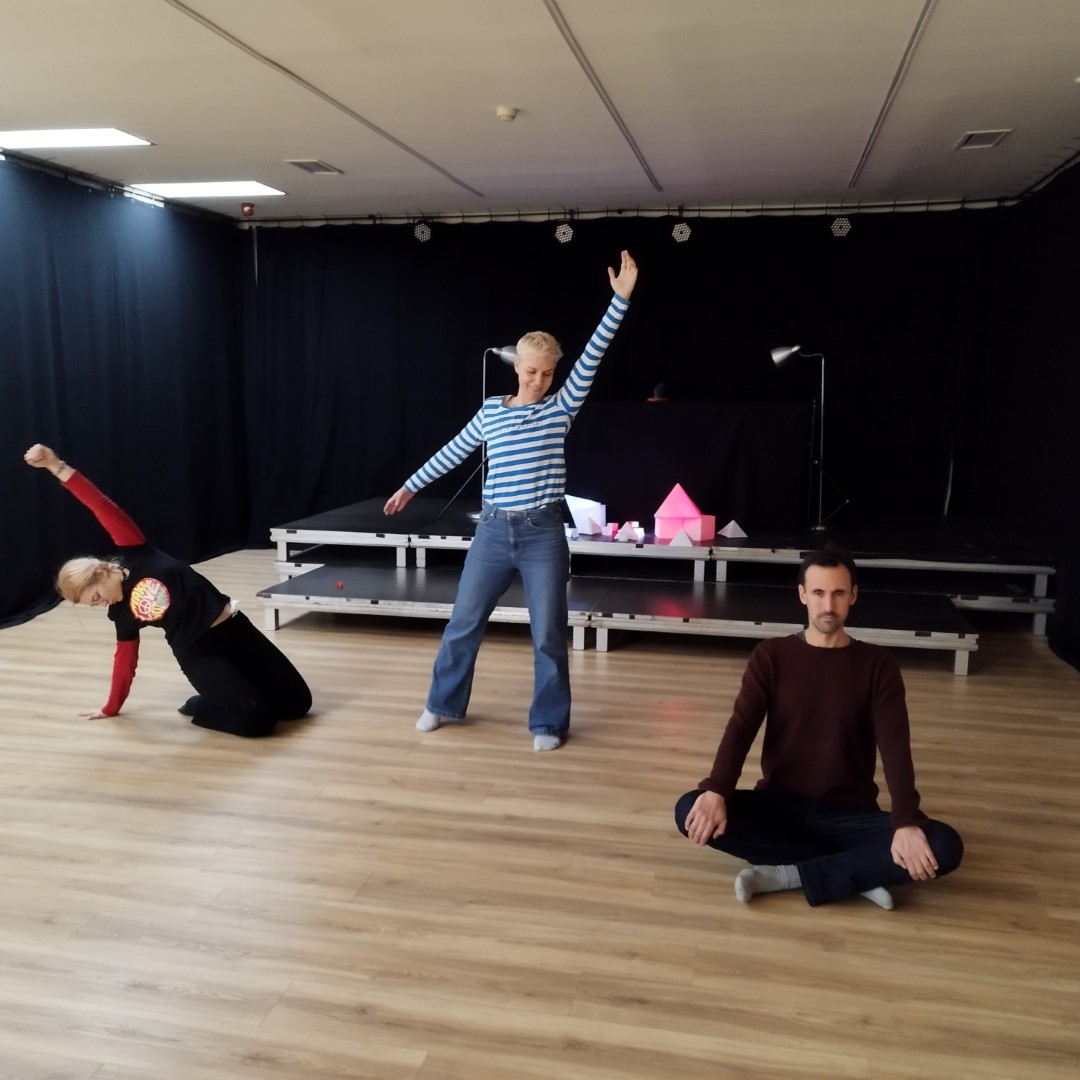
Between 2021 and 2022, Edit Katalin Huszthy, Assistant Lecturer at the Department of Architecture at the University of Debrecen, completed the Fundamentals of Character Building – Michael Chekhov Acting Technique® course series in connection with the theses of her doctoral dissertation.
I am deeply grateful that through her active participation, she made the exploration, perception, and shapability of Atmosphere, Psychological Gesture, Attitude, Center, and Composition present for everyone; and that during the Light and Its Gesture co-arts training, she took part as an active creator in the emergence of objects, environment, and stage design through practical discovery.
It is a particular honour that in her doctoral dissertation she adduces these exercises as evidence for her theses on the shaping of space purely through the power of imagination.
I highlight and quote the passage below:
Excerpt from the Doctoral Dissertation
"The same dynamic unfolds during movement in space. In his course grounded in the Michael Chekhov method, Levente Turóczi developed a practice of imaginative techniques directing attention to the atmosphere-creating potential of the relationship between space and the individuals moving within it. A space is not only mapped and understood through bodily movement within it, but the sight, motion, and posture of the body itself defines it. Therefore, while predetermined static playing spaces constrict, spaces developed improvisatively in the course of play foster the interaction between the environment and the performers, and thereby expand the possibilities of creating atmosphere. Adapting to this type of performance method, the foundation of design work is not the formulation of a preconceived vision attached to a given theme, but the spatial assessment and understanding of its mood. The group trainings dedicated to this purpose include simple tasks aimed at spatial intervention, realised through movement improvisation exercises such as walking with specified direction and quality, directed ball-tossing, or the precise mutual positioning of participants. This is followed by the formation of free associations and the search for analogies while exploring the mood and fluctuations of the space, as well as establishing connections between space and colours, forms, movement qualities, and modes of behaviour. Subsequently, as a kind of subjective survey, the goal is the formulation of various gestures that also manifest in lasting form within the space. Throughout the exercises, the directions and focal points of the given space are determined, providing the foundation for spatial intervention."
Scientific Sources & Professional References
Doctoral dissertation repository: https://mome.hu/hu/doctoral-dissertations
List of publications: https://m2.mtmt.hu/gui2/?type=authors&mode=browse&sel=authors10036732
Department of Architecture, University of Debrecen – Assistant Lecturer Edit Huszthy: https://epitesz.unideb.hu/huszthy-edit
Among the proposed theses, Thesis 8 and Thesis 6 relate specifically to the artistic possibilities offered by the Michael Chekhov Technique:
Featured Theses from the Dissertation
Thesis 8
"Proceeding from the above, I arrived at the premise that the scenographer's activity may be directed not merely toward creating the stage image, but toward creating the conditions and instruments of performance work, as well as mapping out the visual alternatives that arise as a consequence of stage presence. Concurrently, the creation of scenic visuality can be understood in close relationship with actor improvisation, as a fine-arts creative process carried out in the open scene, in the 'here and now'."
Thesis 6
"The intertwining of different artistic disciplines, along with the evolving relationship between performers, audience, and scenic space, enables design work to encompass not only the visual aspect, but in conjunction with it, the somatic impacts on stage. Auditory, tactile, olfactory, and potentially oral stimuli are inseparable dimensions of space and thus of the performance space, influencing the visual experience as well."
The article was also published with identical content on the website of the Research Institute for Art Theory and Methodology of the Hungarian Academy of Arts (MMA MMKI).
Actor Presence and Imagination
**The Chekhov Technique** focuses on the actor's imaginative faculty and physical presence. **Its tools:** the "psychophysical gesture", the body's three centres (will, feeling, thinking), their reciprocal interaction, and the conscious application of imagination.
The Chekhov Technique in a nutshell.
"The question is not how talented we are, but what obstacles we have. If we want to increase our talent, we will encounter many disappointments. There is nothing to increase! The question is how to unlock that secret room where our genius lies." – Michael Chekhov
The Chekhov method equips the actor with practical tools that lead directly to the genuine expression of their personal capabilities and individual creativity. It simultaneously develops the actor's conscious presence, creative willpower, and perceptive sensitivity. This process activates every known and latent capacity of the actor, carrying them beyond their habitual limitations into a state of complete "naturalness". Its impact is immediately felt. The actor learns to trust their own inspirations and capabilities, regarding everyone as a free creative artist.
One of its primary tools is imagination – awakening the imaginative faculty and creating living atmosphere. The actor can use an imaginary body or Psychological Gesture to create and discover their character. Through this, they explore the character's movement, speech, inner feelings, and the world in which the character exists.
Throughout the course, through movement and imagination exercises, we create the opportunity for ourselves and fellow participants to unlock creative energies. With this energy, we connect to the centre of our chest (Imaginary Center), the surrounding space, and each other.
Completing the course creates the opportunity to develop creative energy and conscious presence. The conscious application of imagination and movement through experienced and expressed gestures becomes a clear, everyday tool for everyone.
Core Themes of the Intensive Days:
- Conscious "use" of our sensing body (expansion-contraction – lightness-heaviness-balance)
- Imagination and imaginative faculty (imagination)
- Creating atmosphere and radiation (radiation)
- Quality and intention (with directions – the triad of thinking, willing, and feeling)
- Working with the Psychophysical Gesture
"The strength of a movement stirs our willpower; the kind of movement awakens a definite desire corresponding to it; and the quality of the movement calls forth our feelings. ... Its purpose is to shape and animate our entire inner life and attune it to the service of artistic intent." – Michael Chekhov
About the Group Process
Movement simultaneously activates the unity of the body: the triad of physicality, thinking, and feeling.
In the group process, relying on this triad, we tune into ourselves – in wholeness, in unity: in the present.
What happens when our physicality, our thoughts, and our feelings pull in different directions in our lives? What happens when they lead in one direction, yet we still feel uncertain? Are there directions that define us? Can we be truly present if we do not set out?
You can be in silence – within the holding medium of the group. You can speak of yourself, from within yourself – within the holding medium of the group. Above all, you can experience a safety in the group where: you can be present for yourself – you can meet yourself – whenever you wish.
If you feel drawn, join us: let us explore your answers together.
Feedback from Courses
During the training you receive something so intangible that liberates you, wherever you may stand on the tree rings of life, below, above, or even...
Why do I recommend it? For instance, because you cannot imagine what you will receive here. Finally when you receive it, you feel you have been enriched with something truly extraordinary,...

All-encompassing expertise combined with a safe, holding atmosphere. I was enriched with experiences and insights that are unique and deeply special.
There is that feeling after a new kind of movement: 'wow, do I have a muscle here too?' After a Chekhov course, I marvelled at my mental muscles in the same way...
Registration & Inquiries
Inquire about the Michael Chekhov Acting Technique course series and our workshops, or reach out to us on our Contact page!